Research Insights 3 min readUpdated
Semaglutide, Tirzepatide and Retatrutide: Receptors and Study Context
Compare the receptor targets and selected primary studies while keeping formulation, population and trial design attached to each finding.

Key answer
Semaglutide targets GLP-1 receptors, tirzepatide targets GIP and GLP-1 receptors, and retatrutide targets GIP, GLP-1 and glucagon receptors. Receptor count is a mechanistic distinction, not a stand-alone ranking of clinical outcomes or research-material quality.
Compare research formats
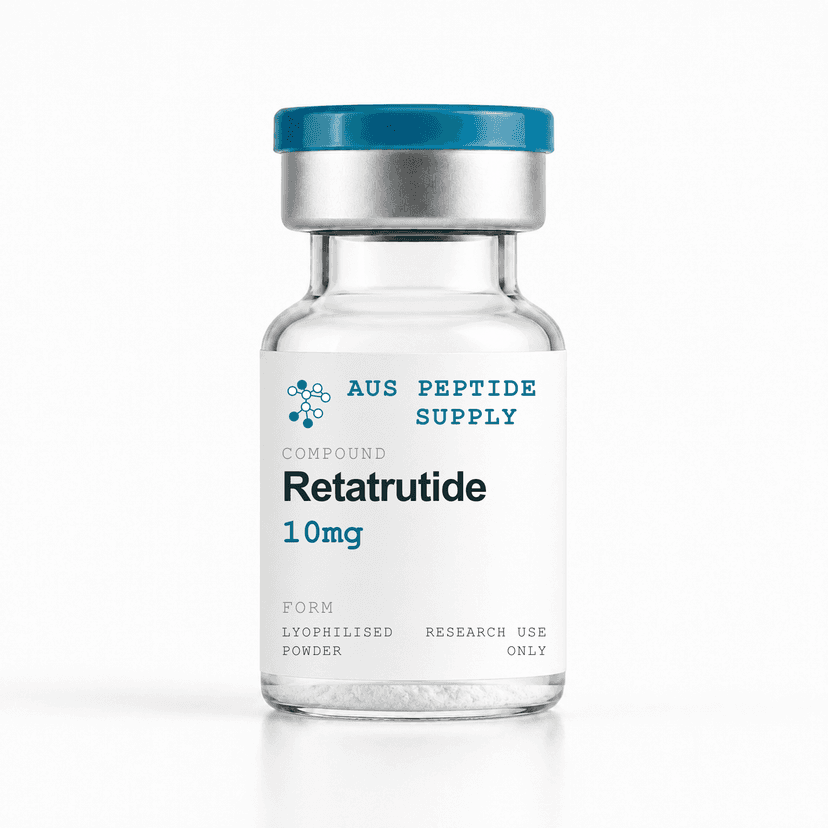
View current prices, availability and analytical-document status on each product page. These catalogue formats are for laboratory research; they are not equivalent to medicines or materials used in a cited study.
These three molecules are often grouped under the GLP-1 label. Their receptor profiles differ, and the evidence should be read at the level of the specific compound and study.
Receptor targets at a glance
| Molecule | Receptor targets | Selected primary study |
|---|---|---|
| Semaglutide | GLP-1 | 2021 overweight and obesity trial |
| Tirzepatide | GIP and GLP-1 | 2022 obesity trial |
| Retatrutide | GIP, GLP-1 and glucagon | 2023 phase 2 obesity trial |
What receptor terminology can tell you
The receptor profile helps identify the pathways a study is investigating. It does not specify the size of an outcome, the balance of benefits and adverse effects, or how a different formulation will behave. Those questions require the relevant experiment.
The retatrutide phase 2 paper studied adults with obesity and evaluated weight outcomes and safety within a defined protocol. It is a source for that investigation, not a direct comparison of every GLP-1-related molecule or commercial research preparation.
Build a comparison from matching questions
- Write the endpoint you want to understand: receptor activity, exposure, weight change, a biomarker or another outcome.
- Record each study's population, formulation, comparator and follow-up period.
- Separate head-to-head comparisons from comparisons assembled across different trials.
- Keep adverse findings and uncertainty alongside the reported outcome.
The study-comparison guide explains why headline percentages from separate trials should not become a league table.
Keep formulation and material identity visible
A matching compound name does not establish that a research vial is equivalent to the material used in a trial. Follow the retatrutide and tirzepatide dossiers for identity questions and source-led context. Read formulation-specific absorption evidence before transferring findings between routes.
Scope of this comparison
The papers above are selected study-reading examples, not an exhaustive current trial registry or an approval-status directory. Use the linked primary records and compound dossiers when a decision depends on a particular study, formulation or current status.
Sources and further reading
- Once-Weekly Semaglutide in Adults with Overweight or ObesityWilding et al. - NEJM, 2021
- Tirzepatide Once Weekly for the Treatment of ObesityJastreboff et al. - NEJM, 2022
- Triple-Hormone-Receptor Agonist Retatrutide for Obesity - A Phase 2 TrialJastreboff et al. - NEJM, 2023
Update record
: Added direct links to relevant research catalogue formats, keeping product listings distinct from the primary studies and trial formulations discussed in the comparison.