Evidence-led research library
Compound evidence, analytical context and the limits that matter
Find the evidence for a named compound, then check its identity, study model and limitations. Each record separates chemical identity from batch quality and human findings from cell, animal or analytical evidence. For a report-reading question, start with the analytical-quality topic below.
Practical research resources
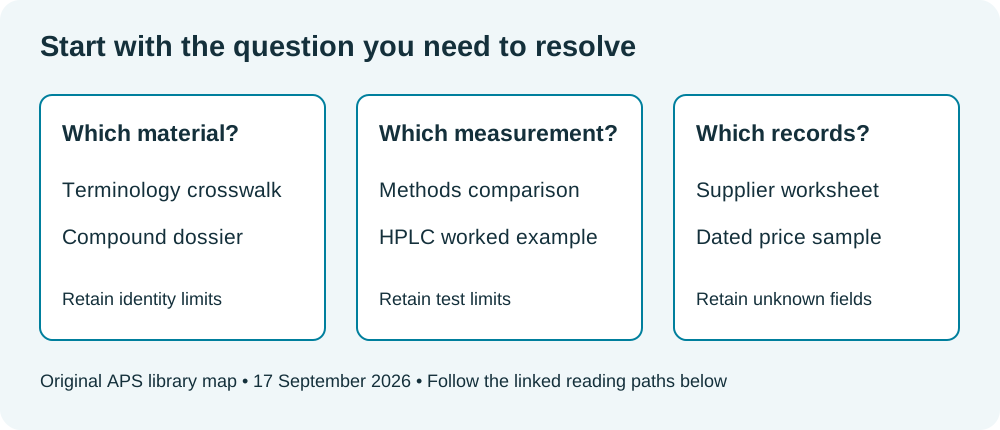
- Which Analytical Method Answers Your Peptide Quality Question?
An original question-to-method reference separating identity, area purity, content, sterility and endotoxin, with a downloadable table.
- Peptide Names, Research Codes and Forms: A Terminology Crosswalk
A source-linked crosswalk for four common naming problems, with explicit limits and a downloadable identity-resolution record.
- Research Peptide Supplier Evaluation: A Laboratory Worksheet
A reusable worksheet for Australian laboratories comparing material identity, documentation, delivered cost and unresolved supplier questions.
- Peptide Identity and Evidence Glossary: What the Terms Mean
A practical glossary separating compound names, forms, purity, content, concentration and evidence stages when reading research records.
Library principles
Claim-level sources
Material statements point to the primary study, regulator or chemical record used.
Evidence stays separated
Human, animal, cellular, analytical and regulatory evidence are labelled rather than blended together.
Connected records
Compounds, methods, catalogue records and related reading form explicit topic clusters.
Connected topic clusters
Start with a research question
Methods cluster
Analytical Quality & Laboratory Handling
How identity, purity, content, batch traceability, storage and laboratory handling answer different quality questions. This cluster favours method limits and source documents over a single headline percentage.
Explore this topicEvidence cluster
Metabolic & Endocrine Signalling
Compound records and comparative research involving incretin, glucagon and growth-hormone-releasing pathways, with human trials kept separate from batch-quality evidence and unapproved-product claims.
Explore this topicEvidence cluster
Neuropeptide & Melanocortin Signalling
A model-aware cluster for Semax, Selank, melanocortin analogues and related fragments. It maps aliases carefully and avoids turning small or jurisdiction-specific studies into broad outcome claims.
Explore this topicEvidence cluster
Tissue, Copper-Peptide & Mitochondrial Research
Connected evidence records for short signalling peptides, copper complexes and mitochondrial-derived or mitochondria-targeting compounds, with counter-evidence and model limitations retained.
Explore this topicCompound index
Evidence dossiers and established guides
New dossiers use a consistent evidence table and review record. Existing guide URLs are preserved and connected here instead of being duplicated or redirected.
BPC-157
Synthetic pentadecapeptide; literature is predominantly preclinical
A source-led reading of rat-derived tendon and cell experiments, including what they cannot establish about human recovery.
Predominantly preclinical
Open recordGHK-Cu
Copper-binding tripeptide complex
A guide to foundational copper-uptake research that separates cellular findings, material identity and formulation claims.
Foundational biochemical and cellular evidence
Open recordSemax
Synthetic ACTH-derived heptapeptide analogue
Selected rat mechanism studies and a small human imaging study, with model-specific findings and limitations.
Limited human and preclinical evidence
Open recordNAD+
Nicotinamide adenine dinucleotide coenzyme
A guide to distinguishing NAD+ from precursor interventions, using a verified human NMN study and its actual metabolic endpoints.
Biochemistry and intervention literature
Open recordRetatrutide
Triple GIP, GLP-1 and glucagon receptor agonist under investigation
An evidence map for retatrutide covering receptor pharmacology, the published phase 2 programme, current uncertainty and identity-testing questions.
Human randomised · Regulatory status
Open recordTirzepatide
Dual GIP and GLP-1 receptor agonist
A source-led guide to tirzepatide identity, dual-receptor pharmacology, human trial evidence and the limits of applying medicine data to research materials.
Human randomised · Analytical identity
Open recordCJC-1295
Growth-hormone-releasing hormone analogue family
A nomenclature-first guide that separates CJC-1295 with DAC from shorter non-DAC material and maps the limited human and analytical evidence.
Human early-phase · Analytical identity · Regulatory status
Open recordMOTS-C
Mitochondrial-derived 16-amino-acid peptide
A model-by-model guide to MOTS-C research, separating its original cellular and mouse findings from later human observational work and unresolved questions.
Preclinical · Human observational · Preclinical
Open recordSS-31
Mitochondria-targeting tetrapeptide
A research guide to SS-31/elamipretide naming, cardiolipin-related mechanisms, early human trials and the gap between mechanistic and clinical evidence.
Preclinical · Human early-phase
Open recordKPV
C-terminal tripeptide fragment of alpha-melanocyte-stimulating hormone
A model-specific guide to KPV nomenclature and the mainly cellular and animal evidence surrounding this short alpha-MSH-derived tripeptide.
Preclinical · Preclinical
Open recordSelank
Synthetic heptapeptide analogue derived from the tuftsin sequence
A guide to Selank identity and its narrow, geographically concentrated human literature, with explicit limits on generalisation.
Human early-phase · Regulatory status
Open recordTesamorelin
Synthetic growth-hormone-releasing hormone analogue
An indication-specific evidence guide to tesamorelin, separating established pharmaceutical trials from unrelated catalogue or body-composition claims.
Human randomised · Human randomised
Open recordMelanotan II
Cyclic synthetic melanocortin receptor agonist
A safety-led guide to Melanotan II identity, small early human studies and the TGA's 2026 findings on unapproved, inconsistently dosed products.
Human early-phase · Regulatory status
Open recordTB-500
Synthetic N-acetylated fragment associated with thymosin beta-4
An identity-focused guide explaining why TB-500 should not be treated as a synonym for full-length thymosin beta-4 and what analytical studies actually found.
Analytical identity · Preclinical · Regulatory status
Open recordIpamorelin
Pentapeptide growth-hormone secretagogue receptor agonist
A guide to Ipamorelin's early pharmacology and human PK/PD work, with clear separation from CJC-1295 and from performance claims.
Human early-phase · Preclinical
Open recordPT-141 / Bremelanotide
Cyclic melanocortin receptor agonist
A guide that maps the research code PT-141 to bremelanotide while separating authorised pharmaceutical evidence from unrelated catalogue material.
Human randomised · Analytical identity
Open record