Scope: analytical documentation and its limits. The table is a reading aid for laboratory records, not a recommendation that a particular sample is suitable for use. FDA/ICH documents explain method principles; citing them does not claim that our materials meet pharmaceutical requirements.
Start with the missing fact
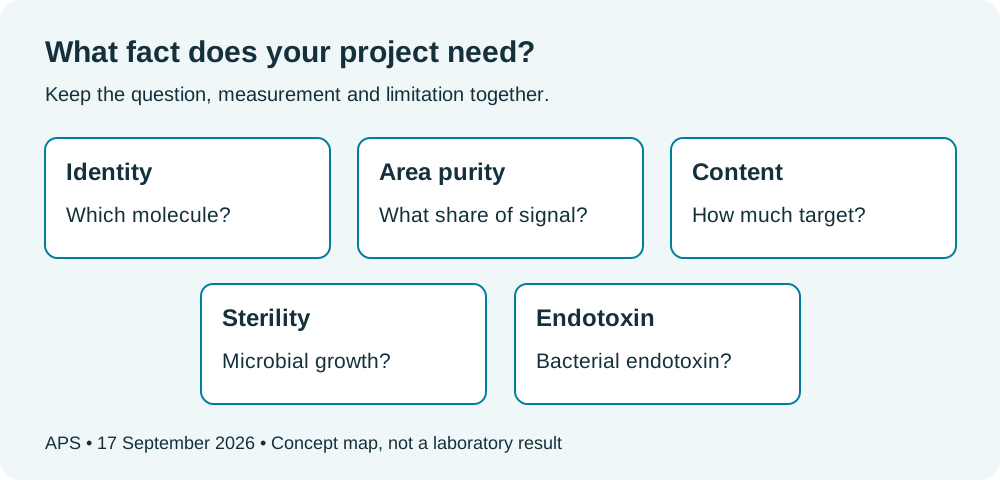
| Method | Question addressed | Record to request | Limit | Source |
|---|---|---|---|---|
| LC-UV area purity | Relative integrated detector response | Chromatogram, wavelength, integration rules and sample ID | Does not establish vial content, sterility or complete identity | Primary source |
| LC-MS identity / impurity work | Mass information associated with separated components | Expected and observed ions, assignment and method | Mass agreement alone may not distinguish isomers or resolve every impurity | Primary source |
| Quantitative content assay | Amount of target on a stated reporting basis | Calibration/reference, units, specificity, accuracy and precision | A label claim or uncalibrated peak-area percentage is not a content assay | Primary source |
| Sterility testing | Microbial growth under the stated test conditions | Sample plan, method, suitability and result | A sample test is not a guarantee for every unit or an endotoxin measurement | Primary source |
| Bacterial endotoxin testing | Endotoxin response under a suitable method | Method, interference checks, units and acceptance limit | Does not establish chemical identity or absence of every type of pyrogen | Primary source |
Download the analytical-method reference (CSV).
Apply the map to a fictional enquiry
A fictional project file contains a label stating 10 mg and a report stating 98.5% LC-UV area purity. The missing fact is measured target content. Record the label as nominal quantity and the chromatographic result as relative signal. Request the content-assay record and reporting basis; do not enter 9.85 mg as though it were measured.
Read the annotated HPLC arithmetic example for the denominator behind that percentage. ICH Q2(R2) provides the framework for assessing a procedure against its analytical purpose.
What should accompany a result?
Keep sample ID, method version, result, units, reference/calibration where relevant and limitations together. If a field is missing, request it rather than inferring it from another test.
Method, ownership and revision record
This original reference organises selected sources by the question a reader needs to resolve. It is not a validated laboratory protocol or an exhaustive review. Version 1.0, reviewed 2026-09-17; next review 2026-12-17. Maintained by the AUS Peptide Supply editorial team, with review ownership assigned to the business operator. Initial release: source-linked comparison and downloadable reference table.
Send corrections through the scientific-document enquiry route. Return to the analytical-quality parent topic or use the supplier worksheet to record an unresolved question.